Client
Flowstaff coordinates a network of 7,000 event professionals across Europe: hostesses, models, and brand ambassadors for high-profile events. The Flowstaff team built the network over five years into a trusted partner for brands that need the right people, fast.
Highlights
- • 4-portal platform (Worker, Recruiter, Admin, Client)
- • ~€200K EU funding secured through Start in Podkarpackie program
The Challenge: Growth Outpacing Infrastructure
Recruitment Ran Through Facebook Messenger
Recruitment ran through Facebook Messenger groups. Candidates replied "interested" to posted opportunities. Every application meant manually copying information from chat threads.
During peak season, the team worked 12-hour days just to keep pace. Growth was limited not by market demand but by how fast recruiters could manually process applications.
Off-the-Shelf Software Assumed a Different Business
Event staffing operates differently from traditional recruitment. Workers apply hours before events, not weeks. Clients select staff based on visual fit, requiring professional photos and rapid candidate selection.
Standard staffing software assumes longer hiring cycles, text-based profiles, and stable assignments. Flowstaff needed something fundamentally different.
Six Months of Searching. No Working Solution.
Flowstaff had already invested significantly. A six-month engagement with another technology partner consumed substantial resources as they explored multiple paths - from Bubble through Airtable to dedicated apps. Each pivot delivered only partial solutions. The project ultimately landed on a Bitrix CRM implementation.
Even that didn't work. When the Flowstaff team contacted Bitrix support about persistent issues, they received a devastating response:
The software was "sold as-is." They were "inventing problems."
This vendor abandonment became a turning point. The challenge was clear: find a partner who could understand the domain deeply enough to build something that actually fits.
Our Approach: Deep Discovery Before Technology
Most failed technology projects share a common pattern: jumping to solutions before understanding problems. We took a different approach: intensive process workshops before any technology recommendations.
Through workshops with the Flowstaff leadership, we built a complete picture of how Flowstaff creates value: every process, every cost, every bottleneck. This model revealed exactly where automation would deliver the highest returns.
This depth revealed that the "technology problem" was actually a constellation of interconnected workflow breakdowns. Each process handoff created friction. Manual steps that seemed minor individually consumed hours in aggregate.
But the most important insight was strategic: Flowstaff didn't need a better CRM or another tool bolted onto the existing model. The data showed an opportunity to transform the business model itself - from a traditional staffing intermediary into a technology-enabled platform company where workers, recruiters, and clients interact directly through a single system.
This reframing changed everything. Instead of automating the old way of working, we designed a platform that removed the manual overhead from the intermediary role. Humans make decisions, the system handles everything else.
From Intermediary to Platform
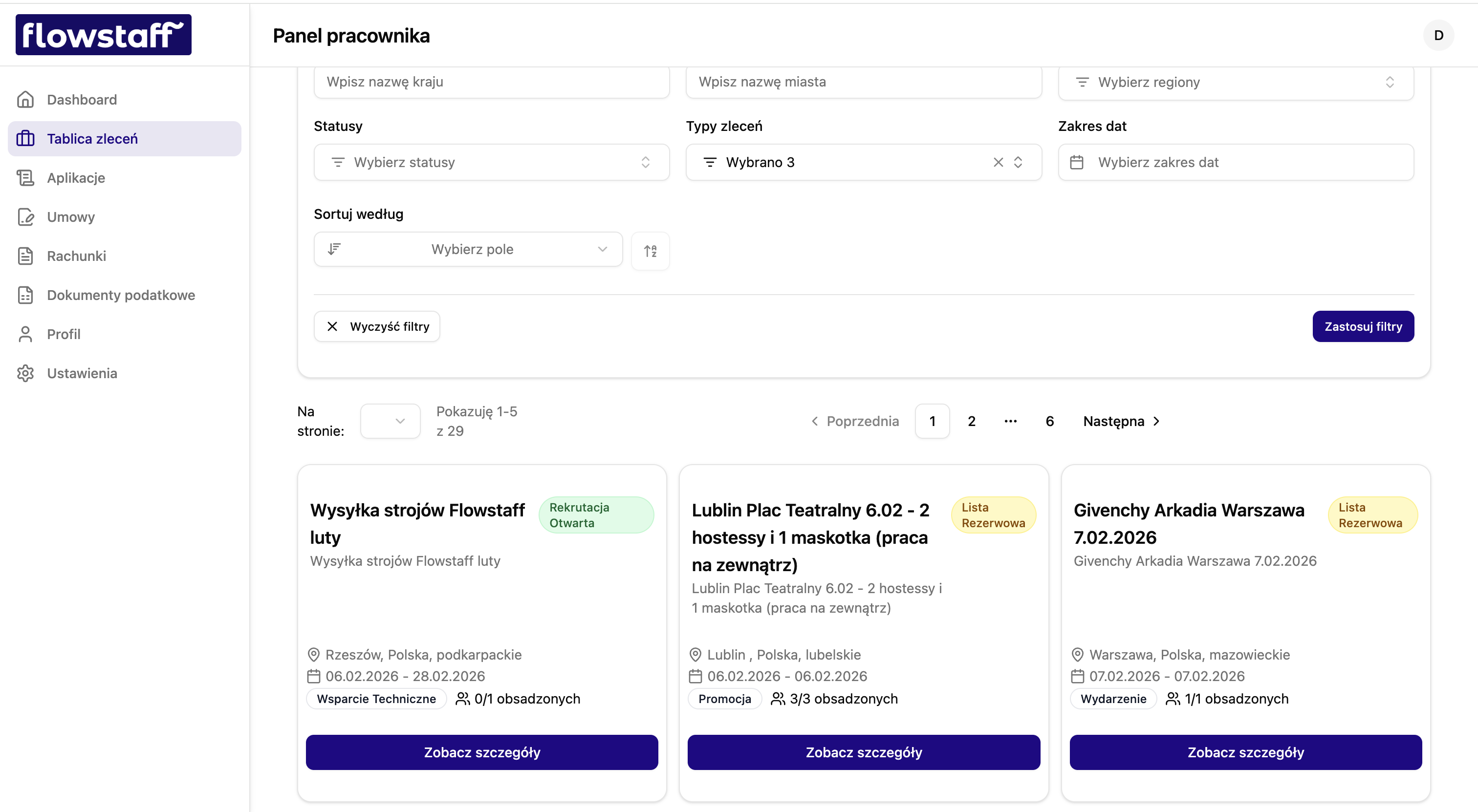
The platform architecture reflects this shift: four portals, each giving stakeholders direct access:
The "Lista Rezerwowa" (Backup List) became a favorite feature during design workshops. When event teams are filled, additional qualified candidates move to a backup list. Last-minute drops, which happen frequently in event staffing, can be filled immediately without restarting recruitment.
Technical Architecture
The architecture follows domain-driven design and clean architecture principles, applying enterprise-grade patterns adapted for lean operations. This produces maintainable code that minimizes long-term development costs. New features integrate with existing workflows rather than requiring system-wide rewrites.
Built on a battle-tested technical stack: FastAPI (backend), React (frontend), Tailwind CSS with shadcn/ui (styling), and PostgreSQL (database). This modern stack maximizes development velocity and is ideally suited for AI-assisted software development, the same approach WFL uses across all projects.
The Transformation in Practice
Workflow Transformation
Before, growth was limited by how many Messenger threads a human could process. Now, the platform dramatically reduces how headcount constrains growth.
Operational Excellence
The platform eliminated the manual overhead that had constrained growth:
- Independence from Facebook: Operations no longer depend on Messenger policies or algorithms
- Scalable capacity: The same team handles significantly more volume through streamlined processes
- Consistent process: Structured workflows ensure every step is tracked and nothing falls through the cracks
- Manageable peak seasons: System support replaced heroic individual effort
Business Model Transformation
The platform didn't just make existing processes faster. It changed what Flowstaff fundamentally is. The company rebranded from Agencja500 to Flowstaff, reflecting the shift from traditional staffing agency to technology-enabled platform. Competitors still operate through Messenger groups and manual coordination. Matching that capability would require the same investment in deep discovery and custom development.
By January 2026, the platform served approximately 1,500 active workers. The platform's impact on Flowstaff's operations strengthened their successful application for ~€200K in EU funding through the Start in Podkarpackie program.
Platform Evolution: Post-MVP Development
The initial platform solved the core operational challenges. But the architecture was designed for evolution, and that's exactly what happened. The platform continued evolving. Since MVP launch, we've added:
- Tax document automation: Complete PIT-11 generation system with Ministry-compliant XML, automated PDF creation, and worker self-service download
- Bank transfer integration: Automated Santander-format payment files with validation and audit trails
- Worker lifecycle management: Automated deactivation at age 26, with manual controls and notification system
- Minor worker compliance: Parental consent document upload and tracking for workers aged 16-18
This isn't just feature development. It's proof that the architectural investment pays dividends. New capabilities integrate cleanly because the foundation was designed for extension, not patching.
Return on Investment
The investment delivered 16x ROI. On the operational side: reduced staffing costs and increased processing capacity. On the strategic side: Flowstaff now owns a proprietary platform asset that strengthens competitive positioning and builds brand equity.
What Made the Difference
Understanding Before Building
Process workshops before any technology decisions. This depth prevented the technology pivots that had derailed previous projects.
A System That Fits How Event Staffing Actually Works
Features like backup candidate lists emerged from actual operational patterns, not assumed requirements. The four-portal design reflected how different users actually needed to interact with the system.
The Founder Could Focus on Business, Not Tech
We took ownership of technical decisions so Agnieszka could focus on business direction. We presented recommendations grounded in domain understanding; she made business decisions. No translation layer needed.
From Skeptic to Advocate
After previous project experiences, Agnieszka approached the partnership with understandable caution. By project end, the relationship had evolved from careful engagement to genuine collaboration.
Client Perspective

After six months of failed technology attempts and a vendor that dismissed her concerns, Agnieszka gave custom development one last chance. The result exceeded expectations.
"You did a great piece of work. I'm incredibly happy that I gave it one last chance, and that chance wasn't wasted."
What started as cautious engagement evolved into a genuine partnership. Building the platform required deep commitment from both sides, with continuous collaboration on process design, feature priorities, and business strategy.
"It wouldn't have worked without both of us being fully committed."
Related insight
The Reasoning Engine: AI-Powered Business Operations